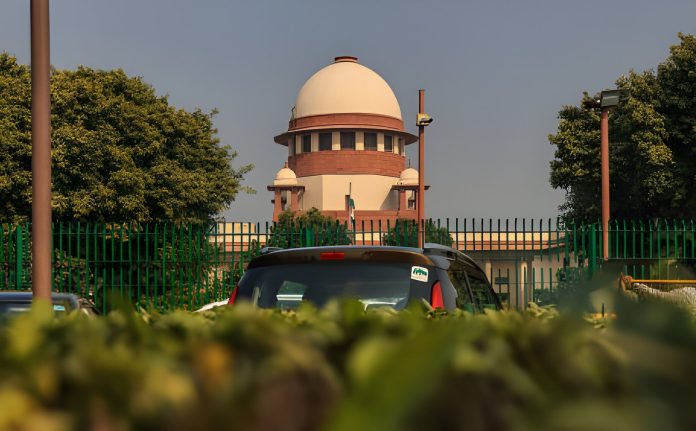
The Supreme Court of India on Wednesday referred the significant issue of whether litigants can directly approach High Courts for anticipatory bail to a three-judge bench. The apex court emphasized the need for clarity on this matter, potentially impacting legal protocols nationwide.
A bench comprising Justices Vikram Nath and Sandeep Mehta decided this crucial reference, stating, “This matter requires to be heard by a three-judge bench.” This decision follows the court’s earlier appointment of senior advocate Siddharth Luthra as amicus curiae to assist in the deliberations surrounding anticipatory bail procedures.
On September 8, the Supreme Court had raised concerns regarding the “regular practice” of the Kerala High Court allowing anticipatory bail applications to be filed directly without litigants first approaching the sessions court. The bench queried, “One issue that is bothering us is that in the Kerala High Court, anticipatory bail applications are regularly entertained directly. Why is that so?”
These concerns arise from the procedural framework established by the Indian legal system. The Supreme Court referred to both the old Code of Criminal Procedure and the new Bharatiya Nagarik Suraksha Sanhita (BNSS), 2023, which outline a clear hierarchy for filing bail applications. Notably, Section 482 of the BNSS provides guidelines for granting bail to individuals apprehending arrest.
Justice Nath noted, “It doesn’t happen in any other state. Only in the Kerala High Court… applications for anticipatory bail are regularly entertained directly.” This deviation from standard procedure raises questions about consistency in legal practice across the country.
The discussion was sparked during a hearing of a plea submitted by two individuals challenging the Kerala High Court’s order that denied them anticipatory bail. These petitioners approached the High Court directly, bypassing the sessions court where most bail applications ideally begin.
The Supreme Court expressed concern that such practices may lead to missing critical factual records typically presented in sessions courts, where a more thorough examination occurs. The bench weighed the options before them, stating, “We are inclined to consider whether the option to approach the high court is a matter of choice for the accused or whether it should be mandatory to first go to the sessions court.”
In a proactive step, the Supreme Court also directed the Kerala High Court to respond to their inquiries through its Registrar General. This exchange highlights the apex court’s commitment to ensuring robust judicial processes and maintaining the sanctity of legal protocols.
The implications of this ruling could reverberate throughout India’s judicial landscape, potentially leading to amended procedures and clearer guidelines regarding anticipatory bail applications. Legal experts predict that the forthcoming deliberations will significantly shape how courts across India will handle such cases, emphasizing the balance between individual rights and procedural integrity.
As the legal community awaits further developments, this case emphasizes the Supreme Court’s role in upholding justice while ensuring that legal frameworks adapt to contemporary needs.