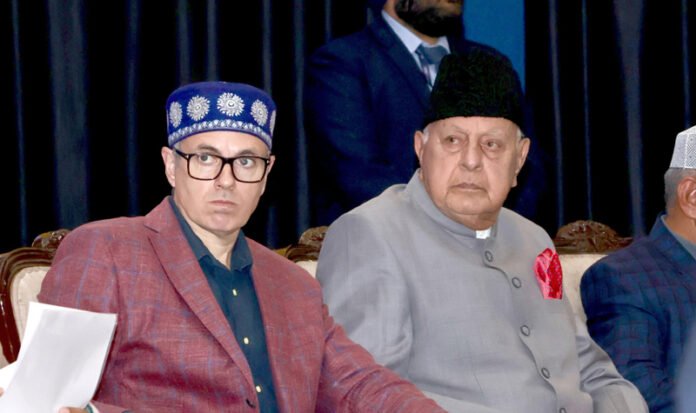
Former Chief Minister and National Conference president Dr Farooq Abdullah stated that Jammu is on a promising path toward inclusive and sustainable development under the leadership of Chief Minister Omar Abdullah. During a recent interaction with a delegation from the National Conference, Dr Abdullah emphasized that the current government is fulfilling the aspirations of the common people—a stark contrast to the hollow promises of the past.
Dr Abdullah highlighted how the elected government has successfully revived public confidence in democratic processes. He noted that the corridors of power are now more accessible to citizens, fostering a collaborative approach to governance. The delegation raised various longstanding public issues that they attributed to a decade of misrule under the BJP.
Members of the delegation expressed appreciation for the corrective and developmental measures initiated by the government, aiming to address the setbacks that Jammu city endured over the last ten years. Dr Abdullah acknowledged these concerns and reaffirmed the National Conference’s commitment to addressing the hardships faced by the people during years of neglect.
“The Omar Abdullah-led government is making rapid strides to restore people’s faith in democratic institutions,” he stated, underscoring the importance of responsive governance.
Criticizing the much-publicized Smart City project, Dr Abdullah remarked on the recent rain-induced waterlogging that has unveiled the inadequacies of the project’s implementation. This underscores the need for accountability in developmental initiatives.
Dr Abdullah also pointed out significant initiatives under the current government, such as the restoration of the historic Mubarak Mandi heritage complex, which faced neglect for years. He highlighted that free transport facilities for women have enhanced mobility across Jammu, while additional ration quotas have eased the economic burden on underprivileged families. The revival of the Darbar Move has re-energized economic activity, providing much-needed relief to local traders.
Upcoming projects, including ropeways, riverside development, and the creation of a lake in Jammu city, aim to position Jammu as a prominent destination on the national tourism map, Dr Abdullah asserted.
He urged party workers to gear up for the Urban Local Body (ULB) and Panchayat elections, underscoring the need for increased public outreach. Special emphasis on youth and women’s representation in governance will align development with their aspirations, providing a more inclusive framework.
In related developments, Chief Minister Omar Abdullah called upon Gujjar institutions to engage in scientific research focusing on climate change and its impacts on the Gujjar-Bakerwal community. Speaking to a gathering at the Gurjar Desh Charitable Trust (GDCT) in Jammu, he asserted that such studies could inform effective future policies.
Describing the former Vice-Chancellor of Baba Ghulam Shah Badshah University, Dr Masud Ahmed Choudhary, as a visionary educationist, the Chief Minister emphasized that identifying and utilizing the community’s talent for climate change research can significantly contribute to the broader socio-economic framework.
“The nomadic lifestyle of the Gujjar-Bakerwal community renders them particularly vulnerable to climate change and its repercussions. By channeling the community’s talent into educational initiatives, including the establishment of Gujjar hostels and mobile schools, we can pave the way for a better future,” Abdullah stated.
He also called for an in-depth assessment of the impact of reservation policies within the community. “While the discussion on reservation has been ongoing, comprehensive studies assessing its real benefits remain scarce,” he lamented.
Dr Farooq Abdullah echoed these sentiments, urging the Gujjar community to unite and prioritize education as the cornerstone for securing a brighter future. The gathering included several ministers, MLAs, civil society members, and prominent figures from the Gujjar community, highlighting a collective commitment to addressing the challenges ahead.