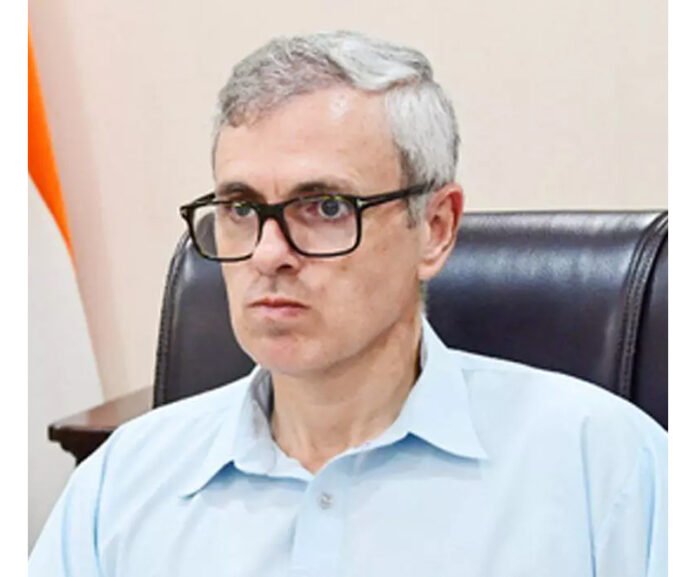
Jammu and Kashmir Chief Minister Omar Abdullah called on Bihar Chief Minister Nitish Kumar to apologize to a woman doctor after he controversially pulled down her veil during a government event on Monday. The incident, which occurred during an appointment letter distribution ceremony for AYUSH doctors in Patna, has sparked significant outrage across the country.
Abdullah emphasized the unacceptability of Kumar’s actions while speaking to reporters in Jammu. “There is no justification for touching a woman’s clothing. Would you do such an act? I would not,” Abdullah said, urging Kumar to make amends. The affected doctor reportedly refused to accept her appointment letter following the incident.
Many see Kumar’s behavior as a blatant disregard for dignity and women’s rights. Abdullah condemned Kumar’s remarks during the incident, where he questioned the woman’s naqab by saying, “What is this?” This raises alarm about the sensitivity needed when addressing women’s identities and rights, particularly in a public setting.
Furthermore, Abdullah criticized the defenses mounted by Union Minister Giriraj Singh, describing the response of the ruling party as expected. He pointed to a double standard in societal reactions, suggesting that had a Muslim leader behaved similarly towards a Hindu woman, it would have sparked widespread protests. “If a Muslim leader had touched the veil of a Hindu woman in Haryana or Rajasthan, there would have been a huge uproar. But since the woman here is Muslim, the BJP finds nothing wrong,” he shared.
Addressing the perceived injustices, Abdullah made it clear that this issue transcends religious lines; it rests on basic human respect and dignity. “How can anyone touch a woman’s clothes like this? Why did the Chief Minister feel the need to do so?” he questioned, advocating for Kumar to acknowledge his mistake.
During the press interaction, Abdullah also touched on the broader implications of such incidents on public perception and political climate. He drew attention to the reactions from various camps, urging a collective examination of respect toward all individuals in political discourse.
In response to comments from Congress leader Prithviraj Chavan regarding national security, Abdullah clarified that Chavan’s statements should not be viewed as the official stance of the Congress party. He expressed that the opposition has stood united with the government and defense forces amid recent challenges, particularly following terrorist activities.
On another note, Abdullah attended the India’s International Movement to Unite Nations (IIMUN) Role Model Series in Jammu, where he reflected on the concept of India’s unity. He emphasized Jammu and Kashmir’s choice at the time of Partition, asserting, “I come from a Muslim-majority state that could have aligned with Pakistan, yet Kashmir chose India. That choice defines the ‘idea of India’ we must protect.”
He acknowledged the need for open dialogue regarding the diversity of opinions in India while expressing concern over recent geopolitical and societal developments.
Further expanding his discourse, Abdullah critiqued the ongoing discussions surrounding religious identity in education and sports in Jammu and Kashmir. Following controversies over medical college admissions and the selection of athletes for the Santosh Trophy, he advocated for a merit-based approach devoid of religious bias.
“The only balance that should matter is between the talented and the untalented. The India I want for our children is one where merit alone determines success—nothing else. Religion should not play any role in how far one can go if they have the talent,” he stated passionately, pushing for a fairer evaluation of capabilities.