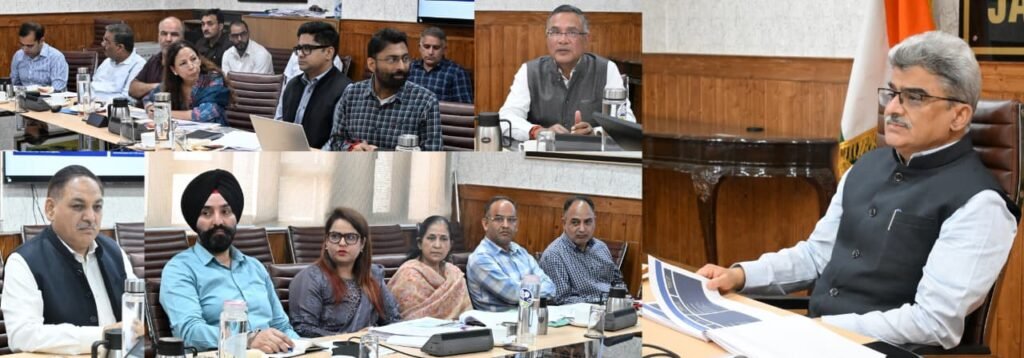
On Thursday, Chief Secretary Atal Dulloo announced that the Pradhan Mantri Skilling and Employability Transformation through Upgraded ITIs (PM-SETU) initiative will invest ₹482 crore to modernize Jammu and Kashmir’s Industrial Training Institutes (ITIs). This investment aims to turn these institutions into industry-ready skill hubs, enabling local youth with high-demand skills and enhancing their employability.
Dulloo made this declaration during the first UT-level Steering Committee meeting, focusing on reviewing the PM-SETU implementation in the region. The meeting brought together key officials from the government and industrial bodies, underscoring the collaborative approach needed for the initiative’s success.
He described PM-SETU as a vital framework for skill education, emphasizing that the upgrade of ITIs must extend beyond just improving infrastructure. “We aim to create an industry-aligned ecosystem that delivers quality skills, leading to well-paid employment for our youth,” stated Dulloo.
The Chief Secretary urged industry partners to contribute not only financially but through the infusion of technology, domain expertise, and modern training methodologies. He called for enhanced cooperation between government bodies, industry leaders, and educational institutions in designing relevant training programmes that match evolving market demands.
Secretary of the Skill Development Department, Kumar Rajeev Ranjan, provided a detailed outlook on the planned institutional architecture and financial contributions under PM-SETU. He highlighted an indicative investment of approximately ₹482 crore over five years, dividing ₹241 crore for each of the two proposed hub-and-spoke clusters.
In the new framework, ten Government ITIs will evolve into modern, industry-oriented institutions organized into clusters, where one Hub ITI will serve four Spoke ITIs. Each Hub ITI will operate as a central technology and resource center, imparting advanced technologies, contemporary training tools, and support for trainers, aiming for an institutional placement rate of 75 percent.
A significant aspect of PM-SETU is its industry-led framework, deploying Special Purpose Vehicles (SPVs) for enhanced corporate engagement in governance and training. This ensures that the training offered stays aligned with real-world job trends and market needs.
Priority sectors for this transformation include advanced manufacturing, automotive, electronics, telecommunications, food processing, textiles, and more, with a strong emphasis on areas showing substantial employment potential in Jammu and Kashmir.
The funding model for PM-SETU follows a tripartite structure, comprising 74.7 percent from the Central Government, 8.3 percent from the UT Government, and 17 percent from industry partners. The estimated costs stand at about ₹81 crore for each Hub ITI and ₹40 crore for each Spoke ITI.
Participating companies are expected to meet specific baseline criteria, ensuring their suitability for collaboration. This includes maintaining an average annual turnover of at least ₹200 crore over the last three financial years and employing a workforce of 500 or more.
Concluding the meeting, Dulloo underscored that the true success of PM-SETU will depend on establishing a consistent flow of industry-ready skilled workers while forging pathways for youth towards improved employment and entrepreneurship, thereby fortifying the economic landscape of Jammu and Kashmir.