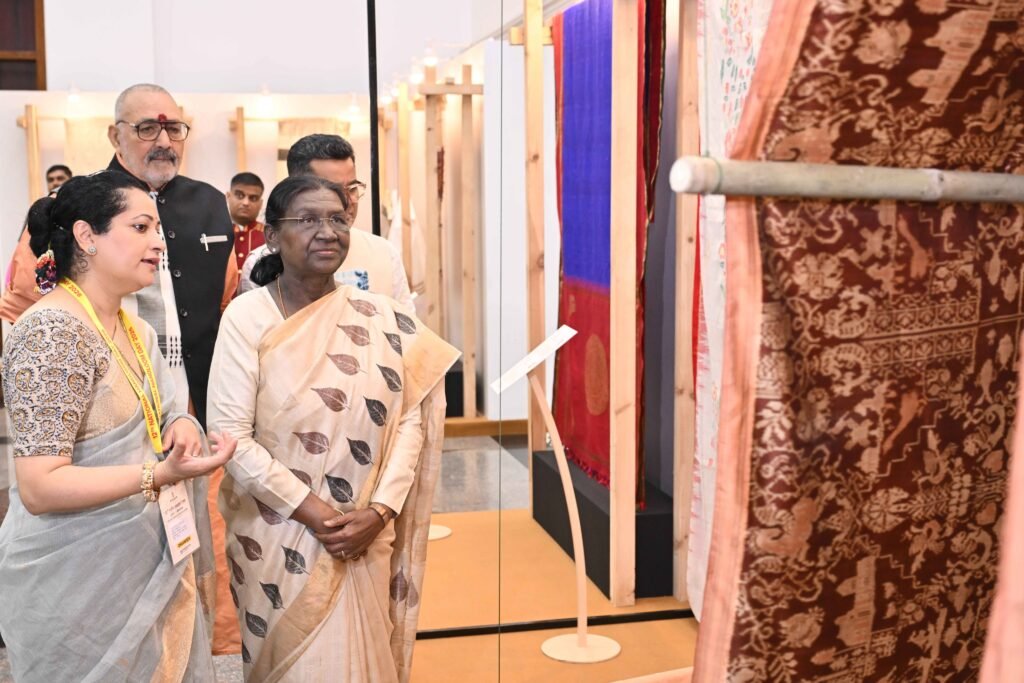
On the occasion of National Handloom Day 2026, President Droupadi Murmu conferred the prestigious Sant Kabir and National Handloom Awards to 22 master artisans at the Rashtrapati Bhavan Cultural Centre (RBCC). This celebration nods to India’s centuries-old weaving traditions and those dedicated artisans who safeguard them.
The awards aim to recognise exceptional craftsmanship, innovation, and significant contributions to preserving India’s rich handloom heritage. The awardees reflect a vibrant tapestry of India’s diverse weaving traditions, including iconic Kanchipuram silk, Banarasi Jamdani, Gujarat’s Tangaliya weaving, and Sikkim’s Lepcha textiles.
The Sant Kabir Handloom Awards, regarded as the highest civilian honour in the handloom sector, were bestowed to three artisans this year. Ram Meher from Odisha received accolades for his exquisite Bichitpar Khadi Saree. Runima Chetiya Choudhury of Assam was honoured for her elegant Muga Silk Saree, while Shah Muhammad Ansari of Uttar Pradesh was recognised for his rare Zarbaft Shewatambari Awadh Jamdhani Saree.
The National Handloom Awards celebrated an additional nineteen recipients, showcasing outstanding achievements in weaving, design development, and marketing. Among the distinguished artisans, various regions contributed unique creations, from Tamil Nadu’s Kanchipuram Silk Sarees to Telangana’s vibrant Ikat Sarees and the half-and-half Jamdani Sarees from Andhra Pradesh.
Special categories honoured women weavers, young talents, tribal crafts, and divyang artisans. For instance, Gopinathan MV from Tamil Nadu and Mantu Basak from West Bengal received special recognition for their excellence in design development. Additionally, N. Venkateswara Rao from Andhra Pradesh and the CH-31 Kovilvazhi Handloom Weavers Cooperative Society from Tamil Nadu stood out for their strong marketing efforts in promoting handloom products.
This year’s award ceremony highlighted a total of 13 states and Union Territories, which included participants from regions like Manipur, Rajasthan, Gujarat, and Sikkim. The recognition shines a light on the extraordinary range of India’s regional textile traditions, showcasing a vast array of luxurious silks, intricate Jamdani patterns, and sustainable, natural-dyed fabrics.
National Handloom Day, celebrated annually on August 7, carries a significant historical context as it commemorates the Swadeshi Movement of 1905. This day serves as a poignant reminder of the essential role that India’s handloom sector plays in preserving cultural heritage, generating rural employment, and supporting the livelihoods of millions of weaving families across the nation.
By honouring artisans dedicated to preserving traditional weaving techniques, the awards reflect India’s unwavering commitment to protect and promote one of its oldest and most vibrant craft traditions.